|
|
|
FROM THE
TRANSMITTING
Tabular statements of the subsidence of the walls of the custom-house at New Orleans, &c.
February 5, 1855. — Laid on the table, and ordered to be printed.
Treasury Department,
February 2, 1855.
Sir: In one of the documents accompanying my last annual report, the attention of Congress was called to the necessity of a change in the plan of the New Orleans custom-house, to remedy, as far as possible, (by lessening the weight of the structure,) the radical defect of placing so heavy a building in a compressible soil. In accordance with the suggestion of that report, authority was given by Congress to this department to make certain changes in the roof and upper floors, by which the foundations will be relieved of an enormous load.
A report has been received within a few days from the superintendent of the building, accompanied by a tabular statement of the subsidence since December 6, 1851, when a bench-mark was first established, and between February 23, 1854, and December 22, 1854. The facts exhibited by this statement are of such importance that I deem it my duty to lay them at once before Congress. It will be seen by the enclosed report and tables, that within the ten months ending December 22, 1854, the building had settled over 4½ inches – an amount equal to the whole previous subsidence from December 6, 1851. This rapid sinking is evidently occasioned by the increased weight, and will, no doubt, proceed at an accelerated rate as the building progresses.
No record of the amount of settlement, prior to December 6, 1851, is on file in this office; but it is presumed that it had settled considerably before the establishment of a bench-mark.
It is proper to state that the forts in the neighborhood of New Orleans have all settled, more or less – one of them many feet; and one of the large hotels in the city, more than three feet. It is fair to infer from these facts, that the amounts of subsidence shown in the enclosed report and tables of the superintendent do not cover the settlement prior to the establishment of a bench-mark of reference; and there is no reliable datum by which to estimate the amount for the future.
The compressible character of the soil, to a great depth, is established, beyond all doubt, by experiments on the spot, and by borings from an artesian well, attempted many years ago in the rear of the city. Experiments made on the compressibility of the soil indicate that the weight of the building is now distributed over the whole area enclosed within its outer walls. If this is the fact, no additional stability would be acquired by the introduction of reversed arches between the walls, by grillages, or by piles. The only measure which promises any relief, is the removal of the groined arches and the substitution of segmental ones, as was authorized to be done for the upper story, and the reducing of the walls, still unfinished, to the least possible thickness compatible with the necessary strength. Whether this alteration will entirely remedy the evil, is rather a matter of conjecture than of certainty. The many elements that enter into a calculation of this kind, must necessarily make the results to be arrived at doubtful. Apprehensions were entertained of the instability of the foundation of this building as early as 1850. A commission was sent that year to examine and report on the subject. Their report contained a full statement of the facts, and was accompanied by a plan for avoiding, as far as possible, all the difficulties; both were laid before Congress, but without resulting in any measures for preventing the apprehended sinking of the building. What was mere conjecture then, is fact now. The very large amount of money already expended, and to be expended, on this structure, and the increasing ratio at which it subsides under each increment of weight, give this subject an importance that admits of no delay. I beg leave, therefore, respectfully to place all the facts before you.
I have the honor to be, very respectfully,
JAMES GUTHRIE,
Secretary of the Treasury.
Hon. Linn Boyd,
Speaker House of Representatives.
Superintendent’s Office, New Custom-House,
New Orleans, December 22, 1854.
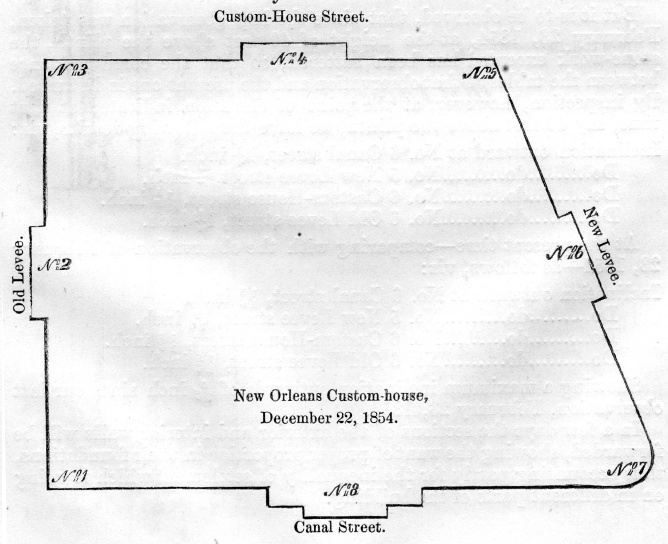
Sir: I enclose you herewith statements in tabular form, showing the settlements of the foundations of the new custom-house, New Orleans, and the inclination outward of the exterior walls, from which you will perceive that the greatest settlement since December 6, 1851, is 727⁄1000, of a foot, or a little over 9½ inches; and since February 28, 1854, 384⁄1000 of a foot, or a little more than 4½ inches. Both points are indicated on the annexed skeleton plan; the latter being No. 3, or the angle of Old Levee and Custom-House street; the former No. 4, or portico on Custom-House street; and I would remark here, that, as a consequence of this unequal subsidence, the plinth stone (No. 17 of the lithographed elevations) is broken through under the window-jamb, showing the fracture quite distinctly: this stone occurs under the second window on the right of the middle portico on Custom-House street front. In this connexion, I would refer to the state of the great central arches. The depression of their crown has been going on until it now amounts to 41⁄16 inches, as compared with the keys of the contiguous ranges of groined arches. This effect appears to spring partly from the great subsidence of the centre projections on Custom-House and Canal street fronts, and partly from the tendency of the exterior walls to incline outwards at those points. The impression thus created appears to extend itself, in a greater or less degree, entirely through the central portion of the structure from New Levee to Old Levee front, exhibiting itself on the latter front in the opening of the joints of panel stones under window-sills, and, in general, at all weak points in the direction alluded to, such as the arched openings in partition walls, &c., one of which openings in the second story became fractured to such a degree that I was compelled to take down the arch and rebuild it; the entire tendency showing conclusively the importance of increasing the weight on the foundations of the central portion of the building before adding to the already too great pressure on the foundations of the éxterior.
By reference to the “tabular statement of inclination of exterior walls,” it will be seen that the greaiest outward tendency occurs on Custom-House street, at Nos. 4 and 5 — say 15⁄16 inch. On Old Levee front, at No. 5, it is 11⁄8 inch at the height of 53 feet 77⁄8 inches above the plinth.
But it is to be observed, that since the last observation was taken, February 23, 1854, at the height of 40 feet above the plinth, the stone-work executed has been battered, so that the correspondence between the tables of that observation and the present one is disturbed. By inspection, however, at the point of elevation indicated at that time, say 40 feet above the plinth, we have the following results, viz:
| Inclination | outward | at | No. 6 Canal street, 11⁄4 inch. |
| Do | do | No. 5 New Levee street, 1 inch. | |
| Do | do | No. 6 Custom-House street, 15⁄16 inch. | |
| Do | do | No. 6 Old Levee street, 11⁄4 inch. |
At the present time — comparing with the observation of February 23, 1854 — as follows, viz:
| Inclination | outward | at | No. 6 Canal street, 15⁄16 inch. |
| Do | do | No. 5 New Levee street, 9⁄16 inch. | |
| Do | do | No. 6 Custom-House street, 13⁄16 inch. | |
| Do | do | No. 6 Old Levee street, 15⁄16 inch. |
Showing a maximum inclination outwards of 5⁄16 inch since our last observation, February 23, 1854.
In a few days the sections of the exterior and interior walls will be forwarded, showing the want of proper proportion in their foundations, thus accounting partly for the inequality of settlement which is going on in different parts of the building.
A detailed drawing will also be forwarded, showing another method of arranging the iron girders, &c. of the central arch, preserving its groined appearance; together with a sectional drawing, showing the manner proposed of arranging the metallic roof, and certain details of the “general business room” and galleries immediately around it.
I remain, sir, respectfully, your obedient servant,
G. T. BEAUREGARD,
Capt. and Bvt. Major Eng., Supt. &c., &c.
Hon. Jas. Guthrie,
Secretary of the Treasury, Washington, D. C.
Levels showing the settlement of the “new custom-house” since December 6, 1851, and since February 28, 1854.
| Total. | Since December 6, 1851. | Total. | Since February 28, 1854. | |||||||||||
|---|---|---|---|---|---|---|---|---|---|---|---|---|---|---|
| No. | 1 | 0.694 | of a foot. | No. | 1 | 0.314 | of a foot. | |||||||
| 2 | 0.655 | “ | 2 | 0.313 | “ | |||||||||
| 3 | 0.747 | “ | 3 | 0.384 | “ | |||||||||
| 4 | 0.797 | “ | 4 | 0.383 | “ | |||||||||
| 5 | 0.561 | “ | 5 | 0.284 | “ | |||||||||
| 6 | 0.561 | “ | 6 | 0.287 | “ | |||||||||
| 7 | 0.382 | “ | 7 | 0.156 | “ | |||||||||
| 8 | 0.763 | “ | 8 | 0.350 | “ | |||||||||
Plan of reference for above levels; the figures corresponding to the points of observation.
|
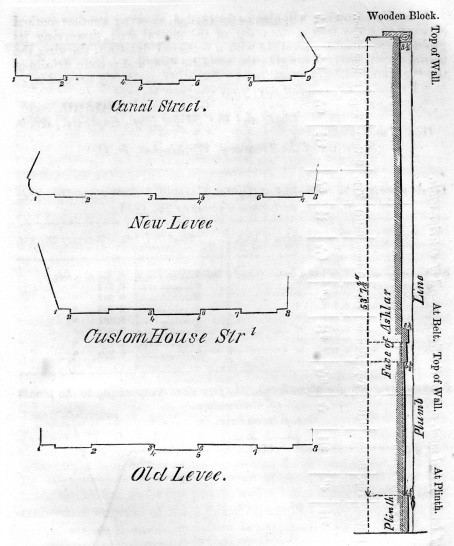 |
Statement of levels of settlement, and inclination outward of exterior walls.
| Canal street. | New Levee street. | Cutom-house street. | Old Levee street. | ||||||||||||||||
|---|---|---|---|---|---|---|---|---|---|---|---|---|---|---|---|---|---|---|---|
| Top. | Bottom. | Top. | Bottom. | Batter. | Top. | Bottom. | Top. | Bottom. | Batter. | Top. | Bottom. | Top. | Bottom. | Batter. | Top. | Bottom. | Top. | Bottom. | Batter. |
| 81⁄16 | 713⁄16 | 311⁄16 | 31⁄16 | 14⁄16 | 81⁄16 | 4” | 314⁄16 | 9⁄16 | 81⁄16 | 710⁄16 | 81⁄16 | 6” | 58⁄16 | 15⁄16 | 81⁄16 | 713⁄16 | 63⁄16 | 53⁄16 | 14⁄16 |
| Point of observation. | Distance to plumb line above the belt. | Distance to plumb line below the belt and above the plinth. | Total inclination plinth to top. | ||||||||||||
| At top of wall. | At belt. | Amount of inclination. | At top of wall. | At plinth. | Amount of inclination. | ||||||||||
| 1 | 81⁄16 | 83⁄8 | 5⁄16 | 63⁄8 | 65⁄8 | 4⁄16 | 9⁄16 | ||||||||
| 2 | 77⁄8 | −3⁄16 | 41⁄2 | 41⁄2 | −3⁄16 | ||||||||||
| 3 | 77⁄8 | −3⁄16 | 53⁄4 | 61⁄2 | 12⁄16 | 9⁄16 | |||||||||
| 4 | 8 | −1⁄16 | 515⁄16 | 613⁄16 | 14⁄16 | 13⁄16 | |||||||||
| 5 | 81⁄8 | 1⁄16 | 31⁄2 | 45⁄16 | 13⁄16 | 14⁄16 | |||||||||
| 6 | 715⁄16 | −2⁄16 | 53⁄4 | 611⁄16 | 15⁄16 | 13⁄16 | |||||||||
| 7 | 73⁄16 | −14⁄16 | 51⁄2 | 53⁄4 | 4⁄16 | −10⁄16 | |||||||||
| 8 | 75⁄16 | −12⁄16 | 35⁄16 | 33⁄4 | 7⁄16 | −5⁄16 | |||||||||
| 9 | 713⁄16 | −14⁄16 | 511⁄16 | 51⁄2 | −3⁄16 | −7⁄16 | |||||||||
| Point of observation. | Distance to plumb line above the belt. | Distance to plumb line below the belt and above the plinth. | Total inclination plinth to top. | ||||||||||||
| At top of wall. | At belt. | Amount of inclination. | At top of wall. | At plinth. | Amount of inclination. | ||||||||||
| 1 | 81⁄16 | 77⁄8 | −3⁄16 | 55⁄8 | 57⁄16 | −3⁄16 | −6⁄16 | ||||||||
| 2 | 77⁄8 | −3⁄16 | 59⁄16 | 57⁄8 | 5⁄16 | 2⁄16 | |||||||||
| 3 | 81⁄4 | 3⁄16 | 61⁄8 | 69⁄16 | 7⁄16 | 10⁄16 | |||||||||
| 4 | 8 | −1⁄16 | 37⁄16 | 315⁄16 | 8⁄16 | 7⁄16 | |||||||||
| 5 | 8 | −1⁄16 | 53⁄4 | 61⁄2 | 12⁄16 | 11⁄16 | |||||||||
| 6 | 79⁄16 | −8⁄16 | 57⁄16 | 59⁄16 | 9⁄16 | −6⁄16 | |||||||||
| 7 | 75⁄8 | −7⁄16 | 215⁄16 | 31⁄16 | 2⁄16 | −5⁄16 | |||||||||
| 8 | 71⁄2 | −9⁄16 | 51⁄8 | 411⁄16 | −7⁄16 | −16⁄16 | |||||||||
| Point of observation. | Distance to plumb line above the belt. | Distance to plumb line below the belt and above the plinth. | Total inclination plinth to top. | ||||||||||||
| At top of wall. | At belt. | Amount of inclination. | At top of wall. | At plinth. | Amount of inclination. | ||||||||||
| 1 | 81⁄16 | 89⁄16 | 8⁄16 | 515⁄16 | 61⁄8 | 3⁄16 | 11⁄16 | ||||||||
| 2 | 713⁄16 | −4⁄16 | 57⁄16 | 63⁄16 | 12⁄16 | 8⁄16 | |||||||||
| 3 | 81⁄8 | 1⁄16 | 61⁄16 | 67⁄8 | 13⁄16 | 14⁄16 | |||||||||
| 4 | 81⁄2 | 7⁄16 | 31⁄2 | 43⁄8 | 14⁄16 | 15⁄16 | |||||||||
| 5 | 81⁄2 | 7⁄16 | 63⁄16 | 71⁄16 | 14⁄16 | 15⁄16 | |||||||||
| 6 | 715⁄16 | −2⁄16 | 513⁄16 | 69⁄16 | 12⁄16 | 10⁄16 | |||||||||
| 7 | 77⁄8 | −3⁄16 | 33⁄16 | 311⁄16 | 8⁄16 | 5⁄16 | |||||||||
| 8 | 83⁄16 | 2⁄16 | 515⁄16 | 61⁄8 | 3⁄16 | 5⁄16 | |||||||||
| Point of observation. | Distance to plumb line above the belt. | Distance to plumb line below the belt and above the plinth. | Total inclination plinth to top. | ||||||||||||
| At top of wall. | At belt. | Amount of inclination. | At top of wall. | At plinth. | Amount of inclination. | ||||||||||
| 1 | 81⁄16 | 713⁄16 | −4⁄16 | 512⁄16 | 55⁄16 | −7⁄16 | −11⁄16 | ||||||||
| 2 | 75⁄8 | −7⁄16 | 37⁄16 | 4 | 9⁄16 | 2⁄16 | |||||||||
| 3 | 715⁄16 | −2⁄16 | 6 | 615⁄16 | 15⁄16 | 13⁄16 | |||||||||
| 4 | 715⁄16 | −2⁄16 | 31⁄2 | 45⁄8 | 12⁄16 | 1 | |||||||||
| 5 | 83⁄16 | 2⁄16 | 39⁄16 | 49⁄16 | 1 | 12⁄16 | |||||||||
| 6 | 83⁄16 | 2⁄16 | 65⁄16 | 73⁄16 | 14⁄16 | 1 | |||||||||
| 7 | 73⁄8 | −11⁄16 | 57⁄16 | 57⁄8 | 7⁄16 | −4⁄16 | |||||||||
| 8 | 8 | −1⁄16 | 513⁄16 | 511⁄16 | −2⁄16 | −3⁄16 | |||||||||
| Main Project Page. |
|
Scanned Original. | ||||||