Chatter
| Volume 72 No. 5 |
May, 2026 |
|---|
Editor’s Notes
The ANA’s convention will be in Pittsburgh this August
– maybe close enough to drive from Chicago for a day or two,
but not simple for many CCC members to enter a Collector Exhibit.
But do not despair!
The ANA will be in Rosemont/Chicago in August of 2027 and 2028!
The contracts are signed, with the dates posted on the ANA’s
website.
Mark your calendar, and consider how you will participate:
volunteering, speaking, enterring an exhibit, or …
all of the above?
Paul Hybert, editor
Minutes of the 1287th Meeting
The 1287th meeting of the Chicago Coin Club was called to order by
President Melissa Gumm at 6:45pm CDT Wednesday, April 8, 2026.
This was an in-person and online meeting with 18 members and three
guests, one applying for membership, present at the CBA and 16
members and one guest (applying for membership) online, for a
total of 38.
Club Meeting Minutes
The March club meeting minutes were approved as published in the
Chatter, both in print and on the CCC website.
New Memberships
Secretary Scott McGowan completed the second membership application
reading for Jeanette Bordelon of Chicago, whose numismatic interest
is coin investing and is a member of Central States Numismatic
Society.
The club voted to approve membership.
Membership application first readings were completed for John Wagner
of Oswego, Illinois, who collects early U.S. coins and American
Silver Eagles with CCC being his first numismatic cub; and a reading
for Joe Dlouhy of Berwyn, Illinois who collects anything numismatic,
is a member of the Hillside Coin Club, and was referred by member
Bob Feiler.
Treasurer’s Report
No treasurer’s reports were available for the meeting.
Old Business
-
Committee Reports:
-
Special Projects Committee - Lyle Daly reported the committee is
reaching out to area schools to provide support for teachers with
numismatics.
Oak Park and River Forest schools have been contacted.
Regarding the club’s AV project to improve the quality of
online meetings, Lyle has only heard of the issue with sound
feedback.
-
Hall of Fame Committee - Deven Kane reported no update.
-
Legacy Project - No Report.
-
CCC meeting at Central States Numismatic Society Convention on
April 25, 2026 at 12:00pm will be integrated into the Newman
Numismatic Portal (NNP) Forum, and live streamed online.
The featured speaker will be Tom Uram presenting on Morse Code
on Money.
The club secretary will send out the link for online viewing when
it becomes available.
Online viewing will be through NNP, not CCC.
New Business
-
CCC membership dues were due by March 31st.
If you have not yet paid, please do so by Mailing a check to the
club at PO Box 2302 Chicago, IL 60690, or ZELLE payment to
treasurer.chicagocoinclub@gmail.com and note the purpose of the
payment.
Dues are $20 per year, and dues for multiple years can be paid.
-
CCC will have our club table at the CSNS convention bourse club
area.
Carl Wolf, Steve Zitowsky, Ray Dagenais, and Scott McGowan will be
staffing the table in booth #2408.
Stop by to say hello, check dues status, or pay your dues.
-
The CCC-NYNC joint club dinner at this year’s ANA will be
held Wednesday, August 26, 2026 at the Allegheny Harvard Yale
Princeton Club, which is walking distance from the Convention
Center.
The Club is offering a buffet dinner for $60 per person.
An email will be sent out for CCC members to confirm attendance.
-
Mark Wieclaw announced there may be club members interested in
purchasing one of the club polo shirts.
He needs a minimum of six shirts for an order.
If anyone has interest in purchasing one of the red or blue CCC
polo shirts, contact Mark Wieclaw at acoinj@gmail.com.
The club secretary will email out information about the shirts.
Featured Program
Mark Wieclaw on What an Odd Lot; A Look at the Odd Denominations
of US Coinage.
Following Mark’s presentation, CCC VP Deven Kane presented
Mark with a CCC Speaker’s Medal and an ANA Educational
Certificate.
Show and Tell
Second Vice President Ray Dagenais announced the seven Show and
Tell presentations for the evening.
Ray reminded the club that in the summarizing of points for Show
and Tell, presenters receive extra points per presentation after
giving five presentations.
President Melissa Gumm reviewed upcoming numismatic events, then
recessed the meeting at 8:44PM CDT to be reconvened Saturday,
April 25, 2026 at noon at CSNS convention for Session II of the
1287th meeting.
The 1287th meeting of the Chicago Coin Club was reconvened –
for session II – by President Melissa Gumm at 12:02pm CDT
Saturday, April 25, 2026 after introduction by Lianna Spurrier of
the NNP Symposium.
This was an in-person and online meeting with 34 members and seven
guests present at the meeting and three members and 14 guests online,
for a total of 58.
President Melissa Gumm greeted all the attendees, especially the
visitors to the Chicago Coin Club, at this meeting at the Central
States Numismatic Society 87th anniversary convention.
Melissa also welcomed all those attending by streaming through
the Newman Numismatic Portal Symposium connection.
Melissa expressed extreme gratitude to the Newman Numismatic
Portal for including the CCC in the 2026 symposium at the Central
States convention.
Melissa reminded all attendees to sign the CCC meeting attendance
book.
Melissa called for a motion for an abbreviated meeting agenda due
to the special convention meeting, which was proposed and approved
by the membership.
Being an abbreviated agenda there was no Old or New Business at
the meeting, other than reminding club members that dues for the
2026 year are past due if not already paid.
Melissa introduced past ANA president Tom Uram for a special
presentation.
Before the presentation Tom asked for a moment of silence for the
passing of Joel Iskowitz, an internationally renowned American
illustrator, painter and stamp, coin, and medal designer.
Iskowitz designed more than 50 coins and medals for the US mint,
including the 2009 Lincoln bicentennial penny and the 2011 Fallen
Heroes of NY Congressional gold medal.
He created more than 2,000 stamps for 40 different countries.
Iskowitz received numerous awards for his philatelic and
numismatic work, including the International Design Awards Gold
Medal, a 2008 silver Medal in Corporate Illustration, and a COTY
nomination for most artistic coin.
Joel passed on April 23, 2026.
As ANA president, Tom had introduced a Triple Crown contest which,
among other requirements, encouraged participants to make
presentations to local coin clubs about the ANA organization, its
value to local clubs, its origins, and benefits.
Tom presented CCC member Dale Carlson with a 1⁄10-ounce
gold coin for his participation in the contest.
Tom also recognized several individuals in the meeting room,
including ANA district representatives, Past ANA president Cliff
Mishler, ANA Governor David G. Heinrich and his wife, and past
CCAC member Dennis Tucker.
Secretary Scott McGowan explained the membership application
process to attendees and announced there were no membership
applications.
Being an abbreviated agenda, there was no treasurer’s
report presentation.
Featured Program
Thomas Uram on Morse Code on Money.
Tom’s presentation was a walk through the amazing history
of communication, from the Pony Express through Morse code to
modern day scanners for retail shopping.
Tom gave all attendees a beautiful color printed copy of his
presentation and a pack of Wrigley Juicy Fruit gum which, as
noted in his presentation gum, was the first item ever scanned.
After the presentation CCC Vice President Deven Kane presented
Tom with a CCC speaker’s medal and an ANA education
certificate.
There was no Show and Tell segment in the abbreviated meeting
agenda.
Secretary Scott McGowan announced the donation of two numismatic
books, to be given away at the meeting.
Jeff Garrett of Mid-American Rare Coin Galleries in Lexington,
Kentucky donated a copy of the current 10th edition MEGA RED
Redbook and a copy of 6th edition of The 100 Greatest
United States Coins.
Both books were been signed by Jeff Garrett.
All in-person meeting attendees had received a red drawing ticket
upon entering the meeting.
Two winners were selected by random drawing.
Bob Leonard’s ticket was drawn for the MEGA RED Redbook
and Frank Gross’ ticket was drawn for The 100 Greatest
United States Coins.
Melissa announced the next CCC meeting will be held May 13, 2026
at 6:45pm, in person at the CBA and online, and listed several
upcoming numismatic shows and symposiums.
President Melissa Gumm adjourned the 1287th meeting at 12:41pm
CDT.
Respectfully submitted,
Scott McGowan, Secretary
Speaker’s Wor[l]d
What an Odd Lot; A Look at the Odd Denominations of US Coinage
presented by
Mark Wieclaw
to our April 8, 2026 meeting
The presentation’s first slide listed the denominations
to be covered, along with their years of issuance.
While seven of the nine denominations were issued starting
from 1851 to 1879, two were issued starting in the 1790s,
just as the mint was starting up.
These two were the copper half-cent and the gold
quarter-eagle ($2.50 face value, because an eagle was a $10
coin).
Some might quibble over some of the included and excluded
denominations – but this is Mark’s presentation
and he defines its scope.
Issued from 1793 through 1857, Mark listed the five design
types of the half-cent and their years of issuance.
While this denomination is a small amount, it was important
during small transactions at that time; it also was useful
in transactions involving the foreign coins then in wide
circulation.
Consider the most commonly encountered silver coins, the
Spanish-American 8-reales coin (the basis for the US dollar)
and its half, quarter, and eighth parts (the 4 reales, 2
reales, and the 1 real coins).
Many prices were stated in terms of the Spanish-American
“dollar’ and its fractions, with an eighth of a
dollar equal to 12½¢, and three-eighths of a
dollar equal to 37½¢.
From 1836 to 1848, and again in 1852, only proof versions of
the half-cents were made.
A major financial crisis in 1837 triggered a severe, seven-year
economic depression, with 40% of banks failing and massive
unemployment.
Copper cent-sized “Hard Times” tokens were
privately produced to meet every-day demands; one half-cent
token was produced and, although not a coin, is regularly
accepted as part of many half-cent collections.
Mark finds numismatic links in many places, as he demonstrated
by showing a US Philippine half-centavo coin (issued 1903-1908)
with the reverse’s central motif being a US shield
topped by an eagle with spread wings.
(This denomination did not circulate well in the Philippines,
with most pieces ending up with collectors.)
Mark likes that motif – so much that he showed an 1893
WCE medal (bronze, 68mm in diameter) for the 1893 World’s
Hygienic Expostion in Chicago with a different take on that
motif.
But back to US coin denominations.
The two-cent coin was issued from 1864 through 1873.
This bronze coin was the first circulating US coin with the
“In God We Trust” motto.
Although popular when introduced in 1864, it started losing
favor when a three-cent coin (in nickel) was introduced in
1865.
The 1865 introduction of small-sized paper Fractional
Currency, ranging in denominations from 3¢ to 50¢,
further weakened demand.
By 1873, the coinage consisted of proof-only issues, with a
mintage of only 600 pieces.
The next denomination, the three-cent piece, was mentioned
twice because it was issued in two different metal alloys.
The silver three-cent piece, or trime, is one of the more
curious coins in US numismatics.
Many believe that it was issued because postal rates were
reduced from five cents to three cents (prepaid) in 1851.
The rising price of silver in 1850 had created a situation
in which the silver content of the issued silver coins was
worth more than the face value of the coins.
From 1851 through 1853, the three cent coin had a silver
fineness of 75%, instead of the 90% fineness of all other
silver coins.
During 1854-1873, the composition of the three-cent coin was
90% silver and its weight was less.
(In 1854, the weights of the other denominations of silver
coins also were reduced, to account for the higher value of
silver.)
After 1862, very few were made for circulation and most were
hoarded.
The coinage Act of 1873 eliminated the trime; many of these
coins went to the melting pot.
The “nickel” three-cent coin was made from an
alloy of 25% nickel and 75% copper from 1865 through 1889,
using a completely different design than on the silver
three-cent coin.
These were necessary because silver was still being hoarded.
Both silver and nickel types were struck from 1865 through
1872.
This type was not popular because fractional currency was in
use and the nickel five-cent coin was introduced in 1866.
A twenty-cent coin, made of 90% fine silver, was issued from
1875 through 1878.
This coin was deemed necessary because the silver half-dime
was eliminated in 1873 and a new market for bullion silver
was “needed.”
However, the size and design of the twenty-cent piece were
very similar to the quarter.
This denomination was much more popular out west, with
1,288,290 pieces minted in those two mints with only 38,500
pieces minted in Philadelphia during 1875.
The mintages in the following years were drastically lower
than in the first year.
Mark took another numismatic side trip with a slide showing
a quarter and a Susan B. Anthony dollar from the late 1970s,
to show what happens when not remembering the past!
The trade dollar was another denomination authorized by the
Coinage Act of 1873, and was issued from 1873 through 1885.
It was struck specifically for export, weighing 420 grains
of .900 fine silver instead of the 412.5 grains of the
Liberty Seated dollar.
From 1873 through 1878 they were very successful –
these were preferred over gold in China where no paper money
was accepted.
In July of 1876, Congress demonetized the trade dollar (the
Coinage Act of 1965 effectively re-monetized them).
The Bland-Allison Act of February 28, 1878 authorized the
government to buy millions of ounces of silver each year and
resume production of standard silver dollars, not minted
since 1873.
Only proof trade dollars were produced after 1878.
Once in Asia, trade dollars typically acquired chopmarks as
they moved through commerce.
Mark showed one coin with so many chopmarks that it became
dish shaped.
Although collectors now are more appreciative of chopmarked
coins, those coins were not welcome back in the US commerce.
It was only in 1887 that trade dollars could be redeemed at
face value in the US, but this was only for non-mutilated
trade dollars – chopmarked coins were valued only for
their silver content, and the price of silver was falling!
The next denomination was the $2½ coin known as the
quarter-eagle, the second coin of this presentation that
dates back to the beginnings of the US mint and coinage.
First issued in 1796, Mark showed the five design types
issued from then through 1929.
In 1848, about 230 ounces of gold were shipped east by the
military governor of California, to be forwarded to the Mint,
where 1,389 quarter-eagles were struck with the letters
“CAL” punched above the eagle on the reverse.
Although not the lowest mintage, these coins bring a
tremendous premium when available.
The last $2½ design type, the Indian Head design of
1908-1929, was like nothing before; the design and lettering
were totally incuse, with the fields being the lowest part
of the die (and the highest part of a struck coin).
The highest part of the coin until 1911, when Denver first
struck this denomination – after the “D”
mintmark was punched into the die’s field, the field
no longer was the deepest part of the die – on a
struck coin, the mintmark was the highest point.
Must be hard to stack these coins, and to find a coin with
an undamaged mintmark.
The three-dollar gold coin, issued from 1854 through 1889,
used an Indian Princess design on its obverse.
The wreath on the reverse is composed of American
agricultural products: corn, wheat, cotton, and tobacco.
Some say that these coins were issued to purchase a sheet of
3¢ stamps.
The initial low mintages before the Civil War gave way to
much smaller mintages.
Mark’s last denomination was the four-dollar gold
“Stella,” so named because of the star on the
reverse.
This was meant to compete with international gold coins, but
never progressed past the pattern stage – they never
really were feasible.
Each contained 0.1929 ounce of pure gold, which was a little
more than the 0.1867 ounce contained in the existing Italian
20 Lire, French 20 Franc, and Spanish 20 Peseta coins, but
less than the British sovereign’s 0.2354 ounce of pure
gold.
Charles Barber designed the Flowing Hair type, while George
T. Morgan designed the Coiled Hair type.
The 1879 pieces were struck for congressmen to examine, while
the 1880 coins were secretly made by Mint officials to sell
to collectors.
Mintages are unknown, but the 1879 Flowing Hair is estimated
at 425 pieces; a handful of the others are known.
Mark named the designers of these denominations, and gave
the size, weight, and composition of them, too.
This detailed presentation concluded with a quick history of
the transition from the bi-metallic system (from a 15:1
silver to gold ratio to a 16:1 ratio), through the Fractional
Currency era, to the gold standard with a floating value for
silver.
Current Advertisers
Show and Tell
Items shown at our April 8, 2026 meeting,
reported by Ray Dagenais.
-
Robert Leonard
likes counterstamped coins and the origins of nicknames for coin
denominations.
He showed five Caribbean-related items.
-
A 1757 Spanish-American 1 real from Lima, with “GR” in
a circle counterstamped on both sides in 1758.
These were issued at the inflated value of 10 pence.
These coins most likely came up the coast of South America,
then overland by mule train, and then by ship to Jamaica.
-
A 1758 Spanish-American ½ real from Lima, with “GR”
in a circle counterstamped on both sides in 1758.
These were issued at the inflated value of 5 pence.
-
An 1834 British 11⁄2 pence coin of William IV.
Though it appears to be a regular British coin of low denomination
– between a Maundy penny and a Maundy tuppence –
it has the value of a Spanish-American quarter real or
quattie.
The entire mintage of this year was sent to Jamaica.
(No Spanish-American quarter reals were ever counterstamped,
because they are so small.)
-
A Jamaican picture postcard, probably mailed 1938-40;
unfortunately the cancellation date is illegible.
It shows two Jamaican girls offering to sell hand-made
“Jackass” rope for a quattie a yard –
roughly two centuries after the nickname came into use!
-
Pridmore’s catalog of The British Commonwealth of
Nations: Part 3. West Indies, the standard catalog of British
Caribbean cut and counter stamped coins.
-
Steve Zitowsky
showed two coins purchased at the National Money Show in Savannah,
Georgia.
-
A silver Axumite coin issued by King Endubis, circa 270-290 AD.
Weighing 2.20 grams and 14mm in dianeter, this coin features a
bust of the king with a cloth on his head of both sides.
The coins of Christian Axum were usually of copper, with a dot of
gold leaf in the center of a cross.
Gold was available in this area, but silver was scarce.
Steve said this coin, graded Choice XF by NGC with a 5/5 strike
score and a 3/5 surface score, is the nicest coin in his collection.
-
A 1666 copper half penny token from Hertford, England.
The obverse bears the legend EDWARD EWER IN WATFORDE, with a
glove (Eure) in the center; Edward Ewer was a glover.
-
Paul Hybert
showed US gold that worried the Assay Commission.
-
An 1847 quarter-eagle (a $2.50 coin) from the New Orleans mint.
-
In February of 1848, the Assay Commission examined the gold and
silver coins which had been set aside for this purpose in 1847.
For the gold coins from each of the four mints, two samples were
formed and analyzed: one was obtained from melting together three
coins of each of the three struck denominations, with the second
obtained by casting a bar from about half of the remaining coins
from that mint.
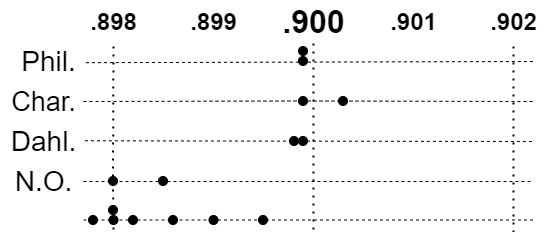
Although the ideal fineness of gold coins was 90.0%, the legal
range was from 89.8% to 90.2%.
The observed results were as expected for Philadelphia, Charlotte,
and Dahlonega, as shown in the following three rows.
The results for New Orleans, shown on the fourth row, required
the Commission to reconvene on the following day, when seven more
samples were analyzed; those results are on the fifth row.
The resulting correspondence between Philadelphia and New Orleans
shows that Melter and Refiner John Riddell likely made honest
mistakes in some of his methods.
He was no longer with the mint at the end of 1848.
An 1853 Senate Report, recently added to our club’s website,
has a summary of the reports of the Assay Commissions examining
coins from 1842 through 1851, in addition to many details for the
above matter.
This is the first instance that Paul has seen of questions raised
by an Assay Commission.
See
http://www.chicagocoinclub.org/lib/us/cis/32-2/s21.html
for the complete report.
-
Jeanette Bordelon
showed two coins that reflect her interest in investment,
intrinsic value, and special designs.
-
A British 2024 gold sovereign, from the Royal Mint, has a
symbol of D-Day on the obverse.
A bust of Charles III is on the obverse while the reverse
has the usual St George Slaying the Dragon motif.
The devices are frosted, on mirrored fields.
-
A silver 5 pound 2026 Angel coin containing two ounces of
pure silver; the reverse features a reinterpretation, by
Sandra Deiana, of an Angel coin of Edward IV.
This coin is in a designer-signed PF-70 Ultra Cameo slab.
The first Angel coin morphed into a “healer”, an
angel of protection – a touch by the king of such a
coin was believed to cure disease.
People holed the coins and wore them.
-
Deven Kane
showed four ancient coins, mentioning that Google Gemini had
generated text “observations” from coin images
provided by Deven.
-
A bronze coin of Faustina II from Abila, one of the
city-states of the Decapolis.
Her draped bust appears on the obverse and a grape bunch
appears on the reverse – the grapes are a visual logo
for Abila, which was renowned throughout the Levant for its
superior wine and fertile soil.
The legends are in Greek, as is the date, which is expressed
as year 226 of the Pompeian Era, or 162/163 AD – within
the early years of Marcus Aurelius’ reign, when
Faustina II was at the height of her influence.
-
A bronze coin of Faustina II, wife of Marcus Aurelius, from
Gadara, another one of the city-states of the Decapolis.
Her draped bust appears on the obverse and a draped and
diademed bust of Zeus, the patron deity of Gadara, appears on
the reverse.
The Greek expression of year 225 in the Pompeian Era, or
161/162 AD, is highly significant because 161 CE was the year
Marcus Aurelius and Lucius Verus ascended to the throne.
The provincial mint in Gadara promptly updated its currency
to acknowledge the new administration in Rome.
-
A sestertius from Rome, circa 164-169, featuring a draped
bust of Lucilla, daughter of Marcus Aurelius and wife of
Lucius Verus, on the obverse.
The reverse features a standing Pietas, holding incense box
and sacrificing over lighted and garlanded altar.
After Verus died and her father passed, Lucilla was involved
in a failed conspiracy against her brother, the Emperor
Commodus, which led to her exile and eventual execution in
182 CE.
-
A gold coin (either a half-dinar or a light-weight dinar)from
Yemen, issued by Queen Arwa bint Ahmad (ruled 1091-1137 AD).
The central obverse contains the Kalima with the Shi’ite
addition referencing Ali, surrounded by what should have
stated the mint and date, but is rendered as decorative marks.
The central reverse lists the titles of her deceased husband,
used by Arwa for dynastic legitimacy, with the surrounding
circular legend largely illegible.
The Sulayhid dynasty was founded by Arwa’s father-in-law
and died with her, because she outlived her four children who
had no heirs.
Even after the dynasty collapsed, these “Arwa-style”
dinars were so trusted in trade that they continued to
circulate and be imitated in Yemen for years – a final
testament to her economic legacy.
-
Tyler Rossi
showed Safe Conduct Passes from the 1983 US invasion of
Granada, after four years revolution and turmoil.
Images of the passes are in the book Grenada –
Revolution, Invasion and Aftermath, by Hugh
O’Shaughnessy.
The banknote leaflet parodied the green Cuban 5 peso note of
1961-1965 bearing the picture of Antonio Maceo, a black hero
of Cuban independence.
The crudely drawn propaganda note is printed in bright
pink-violet, and was created by Patrick Cates, an 81E Combat
Illustrator and a member of the US Army 4th Psychological
Operations Group.
The text on the front in both English and Spanish is:
SAFE CONDUCT PASS.
To those who are resisting the Caribbean Peace Force.
You will be taken to a safe place where your needs will be met.
Food, clothing, shelter and medical treatment is available.
The back of the banknote leaflet has SAFE CONDUCT at the top
and bottom of the note in English and Spanish.
It has been noted that: The use of a Cuban rather than a
Grenadian note showed that planners were understandably more
concerned with resistance from the Cuban construction
battalions than any from the Grenadian local defense forces.
-
Mark Wieclaw
showed several items.
-
A gold National Championship medal from 1894 in fencing,
Foil division.
It was the first of 27 National Championship fencing medals,
11 of which were gold, awarded to Charles Bothner.
In 1897, he won gold in all 3 divisions, (Foil, Saber, Apee),
the only person to ever do so.
-
An assortment of pocket pieces, well-loved coins that would
at best grade at Fair/About Good.
Some were purchased as-is, while others were carried by Mark.
-
An undated Morgan and a 1924 Peace dollar.
-
Three Booker T. Washington half dollars.
-
An 1833 Bust Half dollar.
-
A Canadian “Loonie” dollar and a 1979 Anthony
dollar.
-
Recent proof coins, with scratches when Mark acquired them:
1999 Washington gold, Washington half dollar, and a 1984
gold $10.
Reminders:
-
You can email to Ray a description of what you will
show at a meeting, to give him a start on this write-up.
-
Send it to cccshowandtell@gmail.com
-
After a meeting, all members who viewed the meeting should
email him their scoring sheet – a listing of each
exhibit number followed by a score (from a low of 1 to a high of
10) is all that is needed.
Our 1288th Meeting
| Date: |
May 13, 2026 |
| Time: |
6:45PM CDT (UTC-05:00) |
| Location: |
Downtown Chicago
At the Chicago Bar Association, 321 S. Plymouth Court, 3rd or 4th floor meeting room.
Please remember the security measures at our meeting building:
everyone must be prepared to show their photo-ID and register at the guard’s desk.
|
| Online: |
For all the details on participating
online in one of our club meetings, visit our Online Meeting
webpage at
www.chicagocoinclub.org/meetings/online_meeting.html.
Participation in an online meeting requires some advance
work by both our meeting coordinator and attendees,
especially first-time participants.
Please plan ahead; read the latest instructions
on the day before the meeting!
Although we try to offer a better experience, please be
prepared for possible diifficulties.
|
| Featured Program: |
Thomas J. Sparks —
A Mighty Talk for the Mighty Eighth
The talk will mirror the presentation Tom Sparks, founder of
the Short Snorter Project, gave at the National Museum of the
Mighty Eighth Air Force in Pooler, Georgia, just before
attending the ANA National Money Show in Savannah.
That presentation focused on the history of the short snorter
tradition and, specifically, 8th Air Force-related snorters
in his collection.
The most significant was a short snorter signed by Clark
Gable and America’s top-scoring P-51 ace, George Preddy,
along with other members of the 352nd Fighter Group (the
“Blue-Nosed Bastards of Bodney”).
|
Important Dates
Unless stated otherwise,
our regular monthly CCC Meeting is
in downtown Chicago, and also online,
on the second Wednesday of the month;
the starting time is 6:45PM CT.
| |
| May |
13 |
CCC Meeting - Featured Speaker - Thomas J. Sparks on A Mighty Talk for the Mighty Eighth |
| |
| June |
10 |
CCC Meeting - Featured Speaker - to be determined |
| |
| July |
8 |
CCC Meeting - Featured Speaker - to be determined |
| |
| August |
12 |
CCC Meeting - Featured Speaker - to be determined |
| August |
25-29 |
ANA in Pittsburgh, Pennsylvania, at the David L. Lawrence Convention Center.
Admission is free for ANA members —
for details, see http://www.worldsfairofmoney.com. |
| |
| September |
9 |
CCC Meeting - Featured Speaker - to be determined |
| September |
17-19 |
ILNA 2026 Annual Coin & Currency Convention
at a new location, the International Union of Operating
Engineers Hall, 6200 Joliet Road, Countryside, IL 60525.
Details, including hours and events, are available at
http://www.ilnaclub.org/show.html |
Chatter Matter
http://www.ChicagoCoinClub.org/
Contacting Your Editor / Chatter Delivery Option
chatter_editor@yahoo.com
The print version of the Chatter is simply a printout of the Chatter webpage,
with a little cutting and pasting to fill out each print page.
The webpage is available before the Chatter is mailed.
If you would like to receive an email link to the latest issue instead of a mailed print copy,
send an email to chatter_editor@yahoo.com.
You can resume receiving a mailed print copy at any time, just by sending another email.
Club Officers
| Elected positions: |
| Melissa Gumm | - President |
| Deven Kane | - First V.P. |
| Ray Dagenais | - Second V.P. |
| William Burd | - Archivist |
| |
| Directors: | Tyler Rossi
Mark Wieclaw
Carl Wolf
Steve Zitowsky |
|
| Appointed positions: |
| John Riley | - Immediate Past President |
| Scott McGowan | - Secretary |
| Elliott Krieter | - Treasurer |
| Paul Hybert | - Chatter Editor, webmaster |
| Jeffrey Rosinia | - ANA Club Representative |
|
Correspondence
All correspondence pertaining to Club matters
should be addressed to the Secretary and mailed to:
CHICAGO COIN CLUB
P.O. Box 2301
CHICAGO, IL 60690
Or email the Secretary at
Secretary.ChicagoCoinClub@GMail.com
Payments to the Club, including membership dues,
can be addressed to the Treasurer at the above
street address.
Payments
Renewing Members
Annual dues are $20 a year ($10 for Junior, under 18).
Annual Membership expires December 31 of the year through which paid.
Cash, check, or money order are acceptable (USD only please).
We do not accept PayPal.
Email your questions to
Treasurer.ChicagoCoinClub@GMail.com
Members can pay the Club electronically with Zelle™ using
their Android or Apple smart phone.
JP Morgan Chase customers can send payments to the Club via Quick Pay.
To see if your Bank or Credit Union is part of the Zelle™ Payments
Network, go to
https://www.zellepay.com
Please read all rules and requirements carefully.
-
The Club has registered the Treasurer.ChicagoCoinClub@GMail.com address
with Zelle™ to receive payments.
-
When you send a payment via Zelle™, we will receive
a notification.
-
Be sure to fill out the “What’s this for?” field
– e.g., “Dues 2026” or “Dues 2026 & 2027”
to pay for two years
-
Once the transaction completes, the Club will receive your
payment typically within minutes, and you will know that
the payment was received.
-
Be sure to have your Location enabled on your phone for the
transaction.
 |
Sharing this complete Chatter issue with a friend is simple.
Just let them scan this code into their smartphone!
|